
Date: 21 October 2025, Faculty of Organizational Sciences, New Building
Time: 11 am to 4 pm
Join us for a transformative 3-hour in-person workshop introducing i5, the innovative pedagogy developed within the PRME community. The session will explore how to empower the next generation of students to tackle global challenges and contribute to the Sustainable Development Goals (SDGs) through creative, responsible management education. The workshop will be facilitated by:
– Ms. Aurora Díaz-Soloaga (MsM, i5 Expert Pedagogy Member), Senior Lecturer, AlmaU
– Dr. Ekaterina Ivanova (PhD, Certified i5 Trainer), Associate Professor, HSE University Graduate School of Business
Participants who register and attend the full workshop will receive a certificate of completion.
Date: 21 October 2025, Faculty of Organizational Sciences, New Building
Time: 11 am to 1 pm
Management education has long been shaped by competition: the race for grades, jobs, rankings, prestige. This logic has produced impressive outcomes, but it has also fostered burnout, silos, and extractive leadership cultures. If we want to prepare students to lead in a world of complexity and crisis, competition won’t get us there.
This workshop offers a live experiment in moving from competition to collaboration. Through role play, improv, and embodied exercises, participants will confront the hidden costs of competitive mindsets and practice regenerative approaches that unlock creativity, trust, and shared purpose. Together, we will co-create insights and strategies for weaving collaboration into the fabric of management education — because the challenges of our time demand emergent strategy and regeneration. Are you in?
Audience: All university stakeholders: faculty and students (max 40 people)
Date: 21 October 2025, Faculty of Organizational Sciences, New Building
Time: 11 am to 1 pm
This moderate-intensity, interactive workshop is a simulation exercise set in a post-apocalyptic Zombie-infested world. It features a series of scenarios in a world overrun by the ‘living dead.’ Participants will roleplay characters in a fast-evolving story of groups of humans seeking to survive in situations filled with danger and surprises. The workshop concludes with a discussion on the pedagogy of solving wicked problems in crisis situations. The session is limited to a maximum of 60 participants.
Contact: Tay Keong Tan — ttan2@radford.edu
Date: 21 October 2025, Faculty of Organizational Sciences, New Building
Time: 1 pm to 4 pm
This moderate-intensity, interactive workshop is a simulation exercise set in a post-apocalyptic Zombie-infested world. It features a series of scenarios in a world overrun by the ‘living dead.’ Participants will roleplay characters in a fast-evolving story of groups of humans seeking to survive in situations filled with danger and surprises. The workshop concludes with a discussion on the pedagogy of solving wicked problems in crisis situations. The session is limited to a maximum of 60 participants.
Contact: Tay Keong Tan — ttan2@radford.edu
Date: 23 October 2025, Faculty of Organizational Sciences, New Building
Time: after the Closing Ceremony (around 7 pm)
As a unique side event to the conference, we invite participants to an immersive seminar that blends sensory experience with managerial insight. Guided by Pavel Lebedev, Professor and DBA Program Academic Director at Moscow Business School MIRBIS, together with Natasa Nana Zajec, WSET, Founder of Rock´n´Roll & Champagne Sensory Lab and facilitator, this session explores management and leadership through the metaphors of taste, balance, and craftsmanship.
Rakia, a traditional spirit of the Balkans, becomes more than a drink: it serves as a lens for understanding organizational identity, decision-making, team dynamics, and the art of leadership.
Participants will engage in a structured tasting journey, accompanied by reflective discussions that connect flavors and aromas to the challenges of leading people and organizations.
Duration: 90 minutes
Capacity: 20 participants
Access: First come, first served
Contact: Dr. Pavel Lebedev — LebedevPV@mirbis.ru
Date: 24 October 2025, Faculty of Organizational Sciences, New Building
Time: 9 am – 1.15 pm
The Global Visioning Conference Series
Connecting Continents, Transforming Learning: A Transdisciplinary Dialogue for Future of Education
Roundtable on: Transdisciplinary Curriculum Development and Pedagogy
Friday, 24th Oct 2025, 9.30 am to 1 pm
Organized by:
MIT World Peace University, Goa
Co-organized and hosted by:
Faculty of Organizational Sciences, University of Belgrade
PRME Anti-Poverty Working Group
MITWPU Universities are one of India’s well-known institutions, starting the university education journey from MITWPU, Pune (An institution with UNESCO Chair). The group has a legacy of over four decades in delivering value-based education with a strong focus on innovation, research and social impact. As a part of the new university development in Goa, the MITWPU is organizing a series of international dialogue under the Global Visioning Conference Series ‘Connecting Continents, Transforming Learning: A Transdisciplinary Dialogue for Future of Learning’. For more information about the event is please check the brochure.
A preliminary agenda of the event is available here.
Panelists:
- Tijana Janković, UN Global Compact
- Sandra Živković, Banca Intesa
- Đorđe Lazić, Egzakta Group
- Dušan Stojaković, Hemofarm
- Jelena Stanković, Faculty of Economics Niš
- Stefan Jovanović, CIRSD
- Adrian Solomon, EIT Manufacturi
Moderators:
- Marko Ćirović, Faculty of Organizational Sciences, University of Belgrade
- Milica Jovanović, Faculty of Organizational Sciences, University of Belgrade
Panelists:
- Katalin Ásványi, PRME Chapter CEE
- Ekaterina Ivanova, PRME Sustainability Mindset Working Group
- Alex Hope, PRME Climate and Environment Working Group
- Al Rosenbloom, PRME Anti-poverty Working Group
- Natascha Radclyffe-Thomas, PRME Chapter UK & Ireland
- Gustavo A Yepes-López, PRME Chapter Latin America & the Caribbean
- Evgenia Pashkevich, PRME Chapter Euroasia
- Agnieszka Domańska-Sikorzak, PRME Chapter Poland
Moderators:
- Margaret Goralski, PRME Chapter North America

Gemma Bridgman
Principal Sustainability Strategist, Forum for the Future
More Information
This lecture will unpack the concept of a just and regenerative mindset, and explore how the mindsets we adopt can either limit or create potential by default. We will then explore what the just and regenerative mindset can look like in action and how it has better enabled some international and global companies across a range of sectors to both drive progress across some of the societal and environmental issues we’re currently facing through creating multiple forms of value.

Gordana Vunjak Novaković
Columbia University
More Information

Ichak Adizes
Adizes Institute
More Information
The speech explores the overlooked but essential leadership skill of implementation in an era marked by complexity, interdependence, and rapid change. Drawing on decades of global experience with consultancy services to businesses, non-for-profit organizations and governments, the lecture focuses on the critical gaps in traditional management education—particularly the absence of training in execution and organizational design.
Key themes include the need for complementary leadership teams, the dangers of individualism in complex environments, the role of organizational architecture in managing change, and the importance of building trust-based, participatory cultures. based on mutual trust and respect It also addresses the future of leadership in the age of AI, arguing that “leading with the heart” will be the defining trait of successful and healthy organizations for a healthier world.

Dr. Raul Villamarin Rodriguez
Woxsen University
More Information
As artificial intelligence reshapes global economies, the critical question isn’t whether AI can replace human capabilities, but how it can amplify human potential across all socioeconomic strata. This presentation examines the Neural Personalized Academic Classification Engine (N-PACE), deployed across 45+ institutions serving 1.1 million students, as a paradigm for equitable AI implementation.
Drawing from cognitive science and deployment data, we explore how responsible AI architecture can bridge economic divides. The N-PACE system demonstrates that when AI preserves human agency and adapts to individual cognitive patterns, it creates multiplicative rather than substitutive value—enabling students from diverse backgrounds to unlock their unique potential.
This research reveals three critical principles for regenerative AI deployment: (1) cognitive augmentation over replacement, (2) preserving human decision-making autonomy, and (3) designing systems that enhance human dignity. Through case studies spanning healthcare, urban planning, and education, we demonstrate how human-centered AI can drive inclusive economic growth while preventing “cognitive atrophy.”
For business leaders navigating AI transformation, this framework offers a roadmap for technology deployment that generates sustainable value by strengthening human capabilities—creating the foundation for regenerative economic systems.

Pavel Luksha
Founder of Global Education Futures, Co-Founder of U4Earth and The Weaving Lab, the Associate Researcher of Learning Planet Institute, and the Fellow of World Academy of Art & Science
More Information
Regenerative economy is not just about fixing what is broken; it is a foundational paradigm shift that creates multitrillion-dollar opportunities across sectors, from food & energy, to finance and creative sectors. Management education must give leaders the tools to activate these opportunities and design for systemic value creation.
Regenerative business models change the nature of competition towards coopetition & alternative ways of value creation, including cooperative models (involving partner networks & customers in value creation in areas such as regenerative agriculture), business+movement building (in areas such as regenerative finance and regen AI solutions), and more broadly, businesses combining for-profit & non-profit activities for “net positive” effect. Additionally, from material standpoint, businesses need to constantly design processes & flows in circular & nature-friendly ways, often leveraging nature-based solutions. This is a different business philosophy that needs to combine business pragmatism with cultural transformation idealism.
Regenerative economy demands new leadership archetypes that traditional schools are not preparing for. Two most essential archetypes are ecosystemic gardeners and social weavers: intentional opportunity space cultivators and opportunity connectors.
Nature informs these leadership archetypes and business models: we learn from ways that natural ecosystems organize and steer themselves – leveraging decentralization & autonomy of participating agents while intentionally creating mutualistic relationships. Nature is not just a metaphor but a teacher of regeneration. Biomimicry, circular flows, and organic forms of governance can inspire both technology and the “soft infrastructure” of management thinking. Leaders must learn to read nature’s logics — and apply them to innovation, governance, and organizational design.
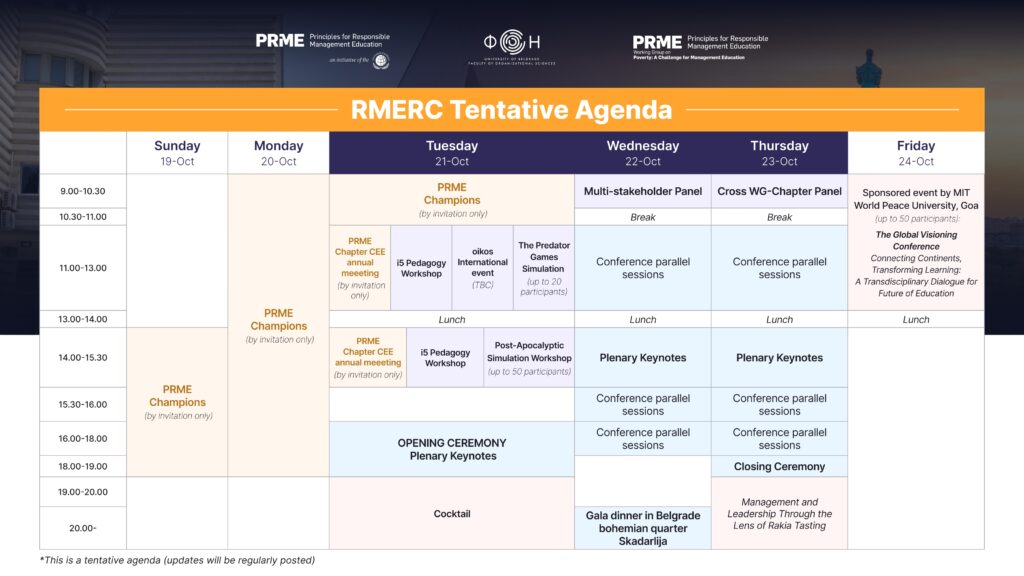
Detailed agenda is available here.
Date: 24 October 2025, Faculty of Organizational Sciences, New Building
Time: 9 am – 1.15 pm
The Global Visioning Conference Series
Connecting Continents, Transforming Learning: A Transdisciplinary Dialogue for Future of Education
Roundtable on: Transdisciplinary Curriculum Development and Pedagogy
Organized by: MIT World Peace University, Goa
Co-organized and hosted by: Faculty of Organizational Sciences, University of Belgrade & PRME Anti-Poverty Working Group
MITWPU Universities are one of India’s well-known institutions, starting the university education journey from MITWPU, Pune (An institution with UNESCO Chair). The group has a legacy of over four decades in delivering value-based education with a strong focus on innovation, research and social impact. As a part of the new university development in Goa, the MITWPU is organizing a series of international dialogue under the Global Visioning Conference Series ‘Connecting Continents, Transforming Learning: A Transdisciplinary Dialogue for Future of Learning’. For more information about the event is please check the brochure.
A preliminary agenda of the event is available here.
Tentative Agenda is Available
A preliminary agenda, program details, and presentation template are available.
For more information on side events and other details, please visit our program section.
A detailed agenda will be published soon.
Call for Contributions
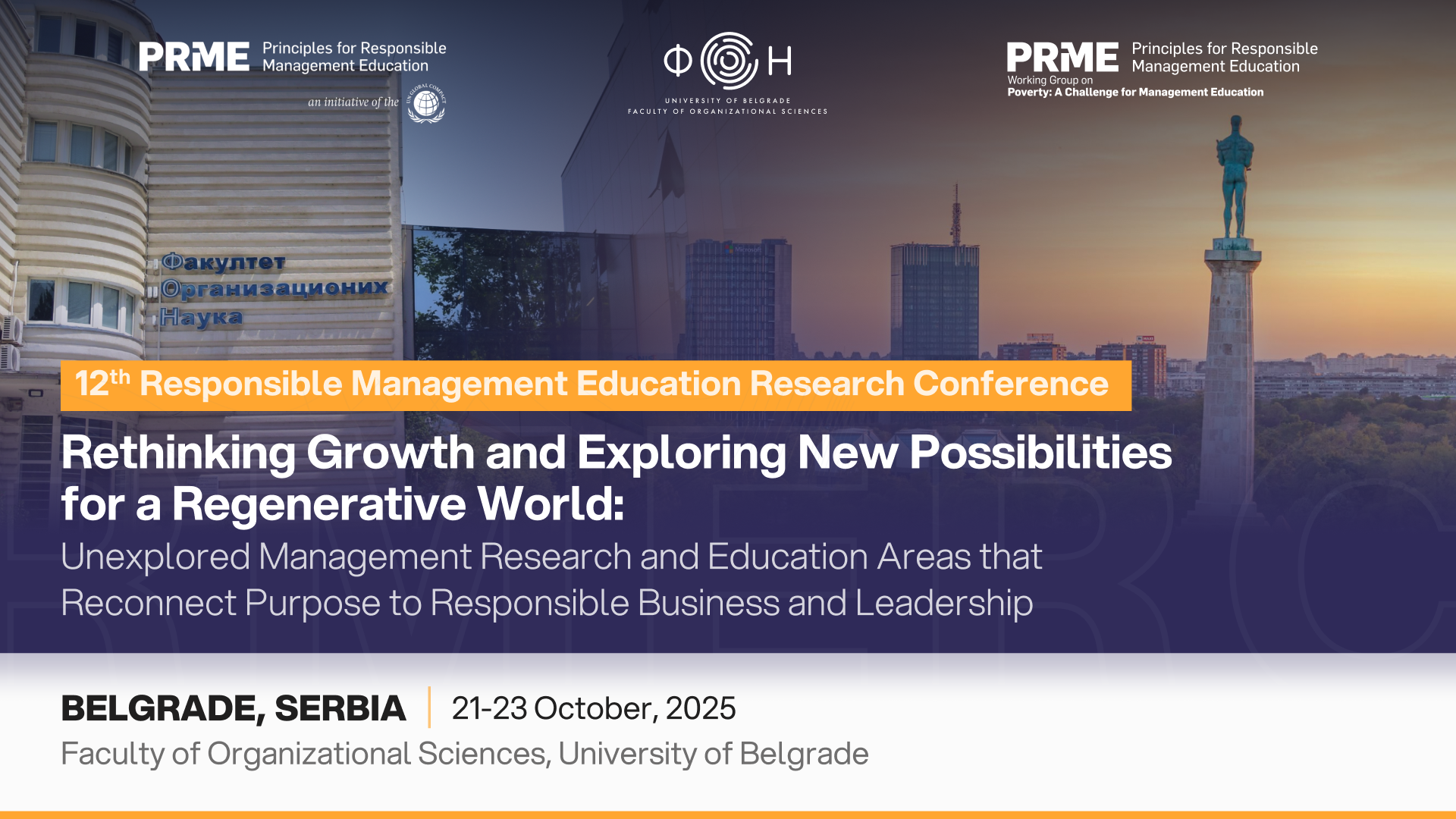
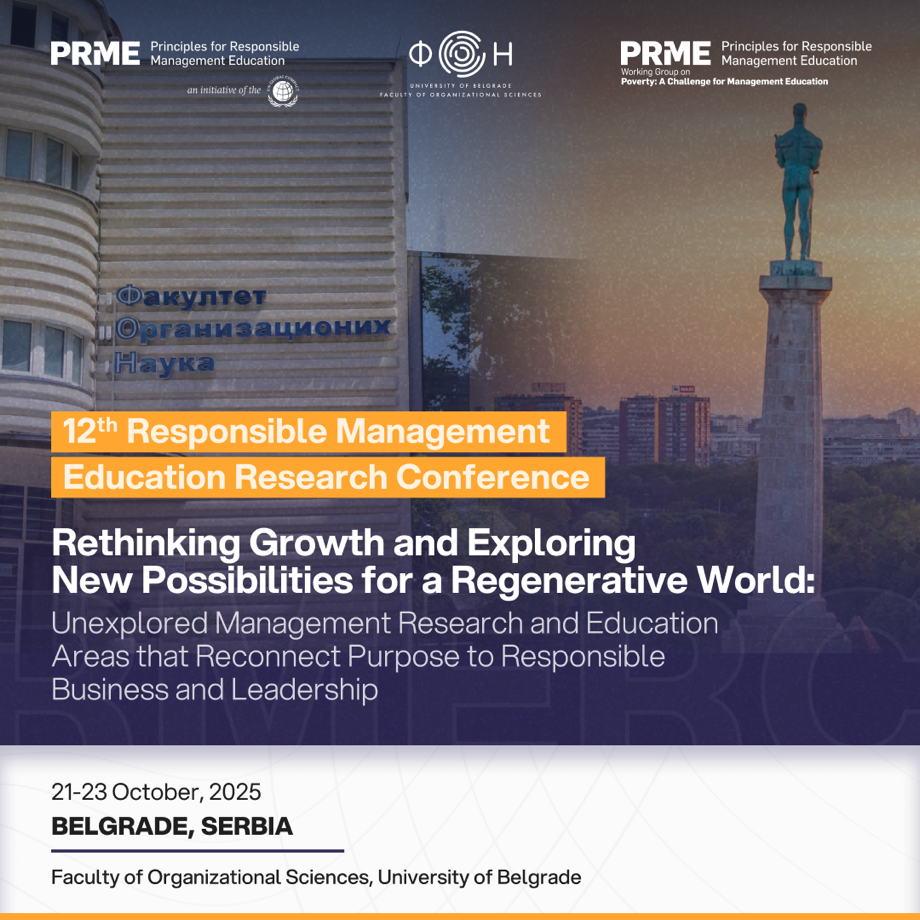
Rethinking Growth and Exploring New Possibilities for a Regenerative World:
Unexplored Management Research and Education Areas that Reconnect Purpose to
Responsible Business and Leadership
Conference Tracks
- Alternative Paths and Models for Socio-Economic Development
- Artificial Intelligence (AI) in RME
- Artificial Intelligence (AI) in RME: Leveraging AI ethically for greater impact in responsible management education
- Beyond MBA: Multi-Track Mastery – Exploring Short Programs, DBAs, and More
- Bridge to the Future: Regenerative Sustainability as Purpose for Business and Leadership
- Bridging Generational Gaps in Business Education: Enhancing Experiential Learning in the Digital Era
- Can Organizations Become Sustainable and Responsible Consumers?
- Climate Change, Sustainability, and Responsible Management Education
- Emerging Technologies, Leadership and Ethics: Implications for Management Education
- Entrepreneurship and Women Entrepreneurship for Regenerative Growth: Implications for Responsible Management Education
- Forward Thinking for Sustainable Education
- Forward Thinking for Purpose-Aligned Growth in the Context of AI and Global Disorder
- From Extraction to Regeneration – Integrating Indigenous Knowledge into Responsible Management Education
- Futuring for the SDGs
- Innovative Pedagogy in Teaching Responsible Management Education
- Learning from Failure
- Management Education for the Common Good
- Positive Tipping Points in and through Business Education
- PRME i5: Transformative Pedagogies for Responsible Leadership: Fostering Holistic Skills for Global Challenges
- Prosperity and Regeneration: Expanding the Conversation around Poverty Alleviation through Action-oriented Research and Innovative Learning Strategies that Advance Responsible Management
- Regenerative Finance – New Financial Ecosystem
- Responsible (Response-able) Management Education at the Historic Turn the World Is Facing: Voices from Different Regional, Historic and Cultural Perspectives
- Student-Focused Research: Using student insights to shape the next generation of responsible leaders.
- Sustainable AI for Sustainability
- The Power of Youth Engagement in Responsible Management Education
- The Future of Education Through the ESG Lens: Challenges and Opportunities for Educational Systems
- Transforming educational and professional landscape: From sustainable toward regenerative HRM
- Unexplored Frontiers in Organizational Sciences: Integrating Responsible Management Education and Regeneration for a Sustainable Future
- General Track
Publication Opportunites
While all approved (AND PRESENTED) contributions will be published in the
- Book of Abstracts.
The Organizers are exploring additional publishing opportunities.
Submission and Review Process
Submission and review process details are available here.
Poster section: The Power of Responsible Student Engagement
Conference Highlights
The RMER Conference format and program, which results from the co-design process, include:
- parallel sessions with approved contributions (papers, abstracts, extended abstracts, work in progress by the conference tracks);
- plenary sessions with keynote speakers and panelists;
- special workshops, roundtables and meetings,
- possible side events, and social program.
We kindly invite you to participate, submit your work, and join us in a collaborative and inspiring environment in Belgrade. For any inquiries, feel free to contact us at: rmerc@fon.bg.ac.rs.
We look forward to your contributions and participation.
Important dates
Deadline for Early Bird Registration
8 September
Deadline for Late Registration
3 October
Supported by
Our friends